Whether or not you need to acid etch or diamond grind your concrete will depend on the type of coating you are applying.
Acid Etching:
When you acid etch concrete, you apply a muriatic acid to the concrete and the acid eats away at the concrete surface to open up the surfaces pores. Many people prefer acid etching over grinding because it’s faster and cheaper. In some cases, you can get away with acid etching, but if it isn’t done correctly, it can result in coating failure, or damage to the concrete. Here are a few other things to consider about acid etching:
- With acid etching, you can typically achieve a maximum concrete surface profile (CSP) of 1. If you don’t acid etch enough, the pores may not be opened up sufficiently to allow for proper penetration and adhesion of a coating. If you acid etch too much, you can cause unnecessary deterioration to the concrete.
- Acid etching creates dust and sludge as it etches the concrete. This dust has to be completely removed so that it doesn’t compromise the coating’s bond.
- Acid etching requires neutralization. If the concrete is not properly neutralized, the acid will continue to eat away at the concrete and compromise the coating.
- During the neutralization process, the concrete is temporarily saturated with an acid neutralizer, such as diluted ammonia or baking soda and water. Once the concrete has been neutralized, a large volume of water is then used to rinse away the neutralizer and the cement dust. If the concrete is not fully dried out after the neutralization process, the presence of water and moisture in the pores and on the surface can cause a wide range of issues including discoloration and coating failure.
- When acid is applied to concrete, you have little to no control over how it will react. This could leave the concrete with a variation in texture and appearance, which may only be enhanced with the application of a coating.
Grinding:
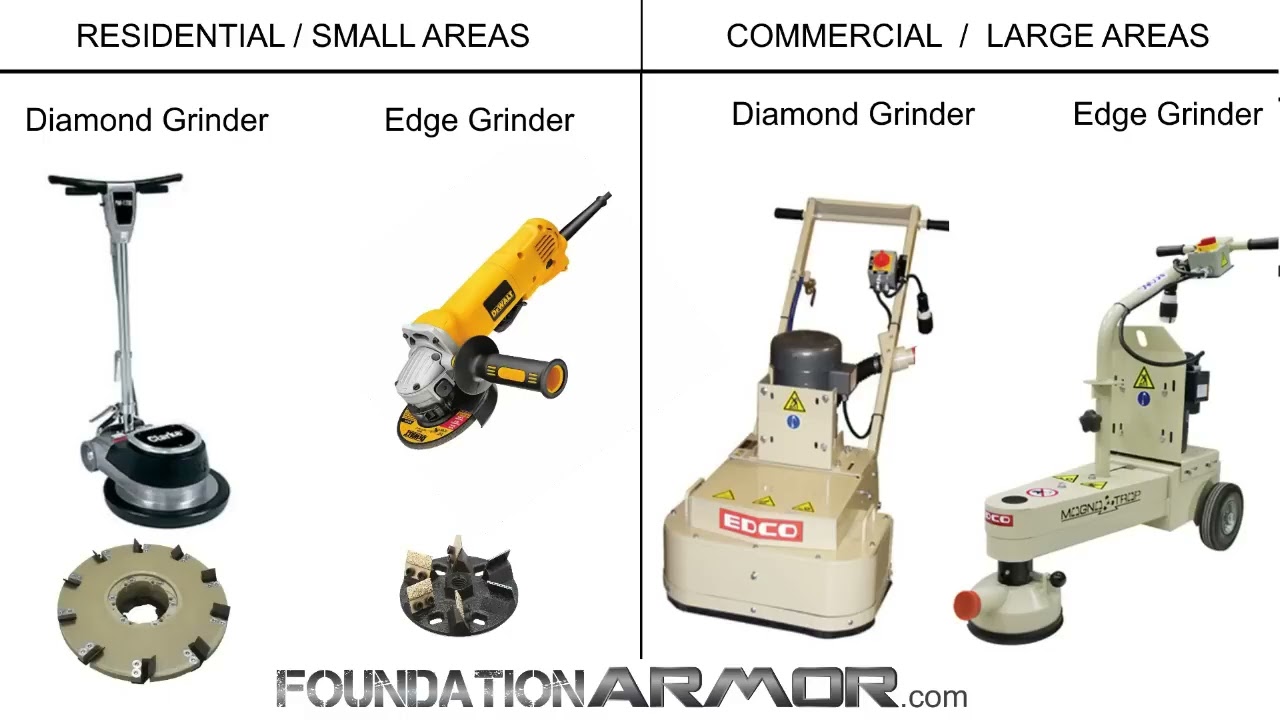
As a coating manufacturer, we always prefer diamond grinding. Grinding ensures you achieve the optimal surface profile for bonding, which then in turn directly impacts the life and performance of the coating. Grinding will also help to achieve a uniform and consistent finish, when done properly.
In addition to grinding, cleaning is equally important. Once the optimal surface profile has been achieved, you’ll want to ensure that all of the concrete dust and particles have been completely removed, and that the concrete has been fully cleaned. If you grind the surface and don’t properly clean the surface before application, the coating will superficially bond to the dust and delaminate.
Coatings are great for many interior concrete applications, but if they aren’t properly applied, you can negatively impact the life, appearance, and performance abilities of the coating. When coatings aren’t properly applied, you can experience discoloration, inconsistent coloring, an inconsistent finish, delamination, or coating failure. It is always best to refer to the manufacturer’s Technical Data Sheet to ensure that your surface preparation is in alignment with their requirements.
Do All Coatings Require Etching or Grinding?
While it’s recommended for epoxy and urethane coatings, not all coatings require etching or grinding. Whether or not you will need to acid etch or grind your surface depends on the type of coating used, and the condition of the floor.
Let’s take for example, concrete wax. Concrete wax needs to be applied to a smooth concrete floor, or over an existing concrete coating. You do not want to apply a concrete wax to a floor that’s been acid etched or diamond-ground. Doing so would result in several issues including discoloration, gloss variation, and coating failure.
Another type of coating that may not require acid etching or griding is an acrylic sealer. Most acrylic sealers can be applied to a clean, dry, and absorbent surface. Now, if the concrete has been polished, or is very smooth and doesn’t easily accept water, acid etching or grinding may be required. If water can’t absorb into the surface of the concrete, an acrylic sealer won’t be able to either. If you are using an acrylic sealer on an interior concrete floor and have questions about whether acid etching or grinding is required, it is best to reach out to the manufacturer of the product you intend to use.
In addition to the type of coating being used, you’ll want to take into consideration the condition of the concrete floor. If the floor is uneven in appearance, coloration, or texture, grinding may be required to ensure a more uniform finish. Most coatings can’t hide imperfections, in fact, they could enhance them. If you are unsure whether additional surface preparation is required before applying a coating, you should consult with the coating manufacturer prior to choosing a coating.